
Arenas, Strings and Scuffed Templates in C
Conceptual notes on VoxelRift's video

G’day.
I recently watched a video by VoxelRifts where he makes development in C a lot easier and so I decided to start incorporating his additions into my standard library and take some notes on them for ease of use.
This article serves as a written handbook-like version of the original video where anyone can just come and ctrl+f the topic they wish to recall and start writing code based on that. For some, including myself, articles are easier to comprehend when trying to quickly recall a topic.
Let’s get to it then.
Linear Allocators (Arenas)
C is a language where we have to manage our own memory, hence its standard library provides us with handy functions such as malloc and free, but we can do better.
Issue with this approach:
it accounts for allocation and deallocation at any point in time.
it's highly general, for our use case specificity is highly beneficial.
The Solution:
For such scenarios, the linear allocator also known as the arena allocator or the bump allocator comes to the rescue.
// Linear allocator struct
void *base_memory;
void *alloc_pos;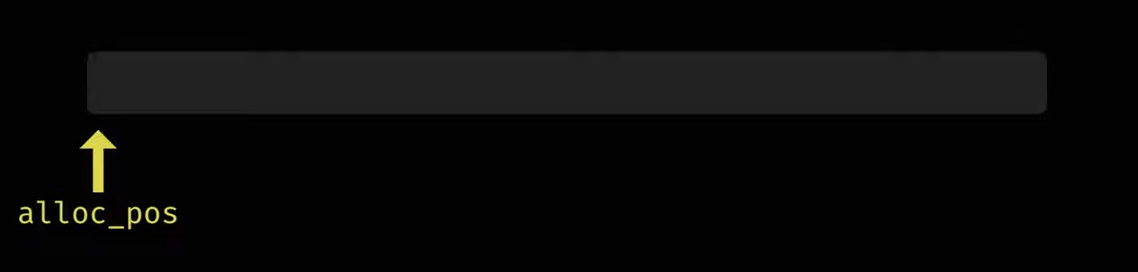
Characteristics
It uses a block of backing memory
base_memory.It uses a pointer
alloc_poswhich points to the beginning of the memory.
Allocating memory
Works just like
malloc
Ask for some sized memory by calling
arena_alloc(size)-> it returns the currentalloc_posthus moving thealloc_pospointer ahead by whatever size you asked for.
The catch
* You can't free memory allocated with this arena, you have to free the entire memory block.
void *allocation = arena_alloc(arena, size);This is enforcing a good thing:
When you allocate some data into an arena you're saying this allocation will live as long as the arena does. This is the definition of lifetime.
Example 1
We're using a library that needs access to 3 separate integers at all times until we call DoneWithUsingLibrary().

With the malloc API, we allocate/deallocate them separately and store them as pointers.
int *a = malloc(sizeof(int));
int *b = malloc(sizeof(int));
int *c = malloc(sizeof(int));

// Use a,b and c
RegisterMyPointers(a, b, c);
DoStuff();

DoneWithUsingLibrary();
free(c);
free(b);
free(a);
With arenas, we allocate them on the same block of memory and free the entire arena at the end.
Arena arena = arena_make();
int *a = arena_alloc(&arena, sizeof(int));
int *b = arena_alloc(&arena, sizeof(int));
int *c = arena_alloc(&arena, sizeof(int));

// Use a, b and c
RegisterMyPointers(a, b, c);
DoStuff();

DoneWithUsingLibrary();
arena_free(&arena);
By itself, this doesn't seem too important, but it is.
Imagine the initialization and freeing are 2 separate functions, as this pattern is common while working with C
void InitLibrary() {
	int *a = malloc(sizeof(int));
	int *b = malloc(sizeof(int));
	int *c = malloc(sizeof(int));
	// Use a, b and c
	RegisterMyPointers(a, b, c);
}

void DoStuffWithLibrary() {
	DoStuff();
}

void FreeLibrary() {
	DoneWithUsingLibrary();
	free(c);
	free(b);
	free(a);
}
Disadvantages:
With malloc and free we need to necessarily store the pointers somewhere even though we are not using them. So we need to pass in some state and manage it.
typedef struct MyLibState {
	int *a;
	int *b;
	int *c;
} MyLibState;

void InitLibrary(MyLibState *state) {
	state->a = malloc(sizeof(int));
	state->b = malloc(sizeof(int));
	state->c = malloc(sizeof(int));
	// Use a, b and c
	RegisterMyPointers(state->a, state->b, state->c);
}

void DoStuffWithLibrary() {
	DoStuff();
}

void FreeLibrary(MyLibState *state) {
	DoneWithUsingLibrary();
	free(state->c);
	free(state->b);
	free(state->a);
}
Yikes... This looks like a pain to manage. Let's try it with the Arena.
typedef struct MyLibState {
	Arena arena;
} MyLibState;

void InitLibrary(MyLibState *state) {
	state->arena = arena_make();
	int *a = arena_alloc(&state->arena, sizeof(int));
	int *b = arena_alloc(&state->arena, sizeof(int));
	int *c = arena_alloc(&state->arena, sizeof(int));
	// Use a, b and c
	RegisterMyPointers(a, b, c);
}

void DoStuffWithLibrary() {
	DoStuff();
}

void FreeLibrary(MyLibState *state) {
	DoneWithUsingLibrary();
	arena_free(&state->arena);
}
Arena Benefits:
We never use the pointers ourselves -> we never have to store them.
We are 100% sure the allocations are right next to each other -> Cache efficiency is achieved.
void FunctionA(Arena *arena, ...); // Does allocate memory for you
void FunctionB(...);              // Doesn't allocate memory
Ability to check whether a function does or not make allocations based on whether it takes in an Arena or not.
Example 2
We want to manipulate our incoming string, but we don't want to pollute the arena with intermediary nonsense.
string U_FixFilepath(M_Arena *arena, string filepath) {
	M_Arena scratch = arena_make();

	string fixed = filepath;
	fixed = str_replace_all(&scratch, fixed, str_lit("\\"), str_lit("/"));
	fixed = str_replace_all(&scratch, fixed, str_lit("/./"), str_lit("/"));
	while (true) {
		u64 dotdot = str_find_first(fixed, str_lit(".."), 0);
		if (dotdot == fixed.size) break;

		u64 range = (dotdot + 3) - last_slash;
		string old = fixed;
		fixed = str_alloc(&scratch, fixed.size - range);
		memcpy(fixed.str, old.str, last_slash);
		memcpy(fixed.str + last_slash, old.str + dotdot + 3, old.size - range - last_slash + 1);
	}
	fixed = str_copy(arena, fixed);
	arena_free(&scratch);

	return fixed;
}
Purpose:
Reduce path to its simplest form
Remove
./patternsRemove
../patterns and one folder name before the last/
Solution:
Initialize a small
scratcharena for quick useBuild the
fixedstring on thescratcharenaCopy the
fixedstring onto the finalarenaFree the
scratcharena
Strings
In C, strings are represented as a pointer to the first character. The end of the string is marked by the null terminator \0 special character.
Strings specified using double quotes will automatically have the
\0character added to them.char*is the data type used by strings.
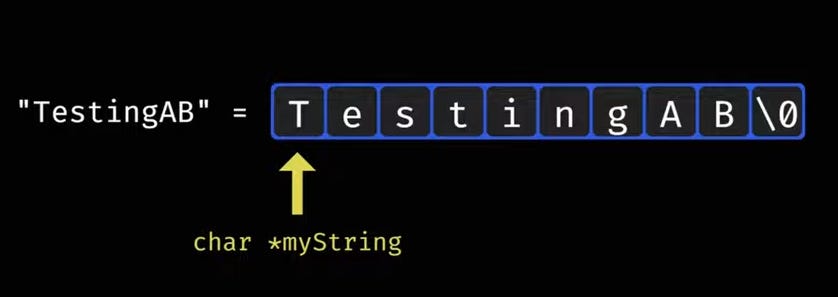
There are a few disadvantages with this approach.
Example 1
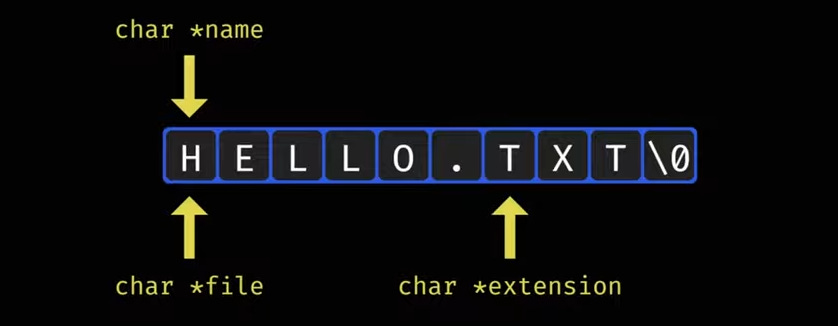
We have a file name stored somewhere in memory that looks like this.
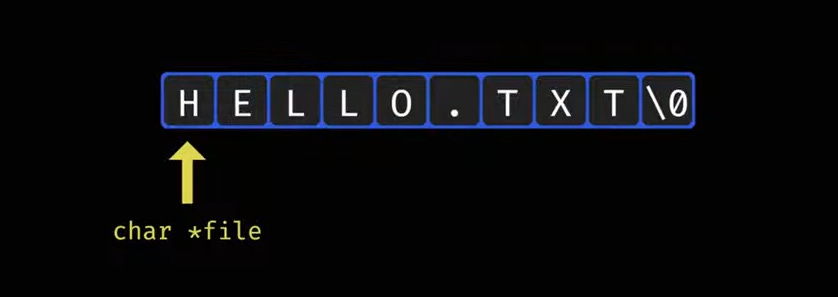
Let's say we want a string that stores only the extension of this file. We can initialize a new pointer that points to the first T in txt, reusing the \0 character for both strings.
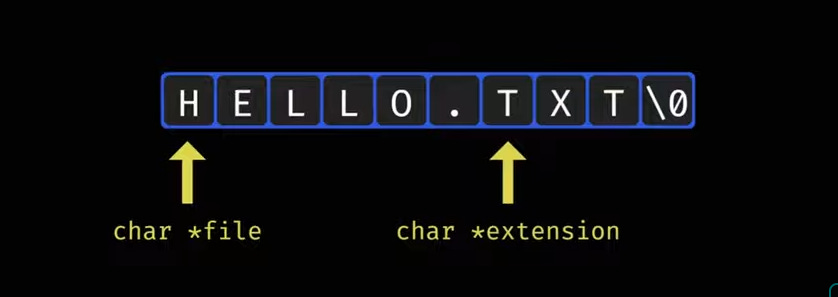
But now... what happens if we only want the filename without the extension?
Simple, pain and suffering.
Common approaches and their issues:
Initialize a new pointer pointing to the first character -> we need to manually check for the end of the filename.
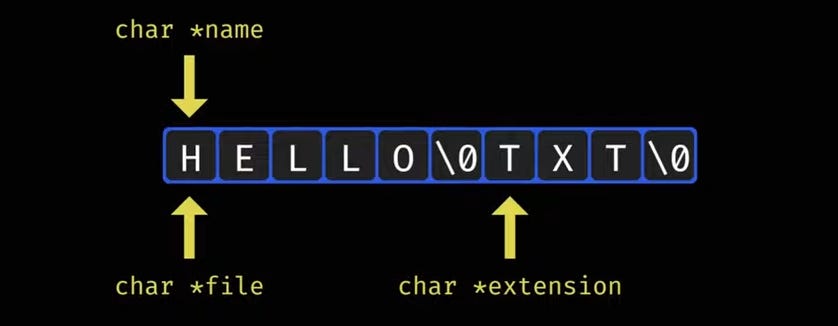
Replace the
.with a\0-> we break the original string.
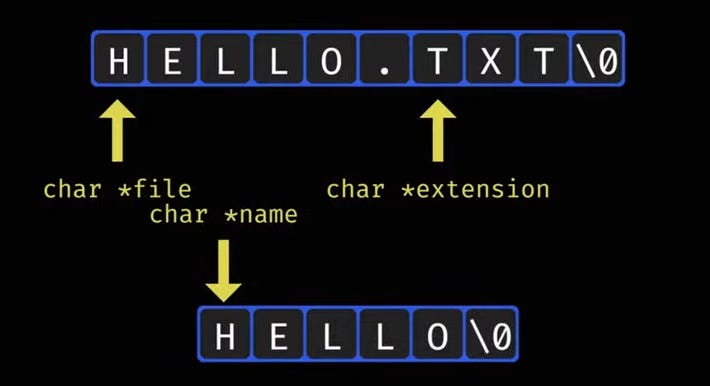
Create an entirely new allocation for the file
namestring -> Do we really need to do that?
The Solution:
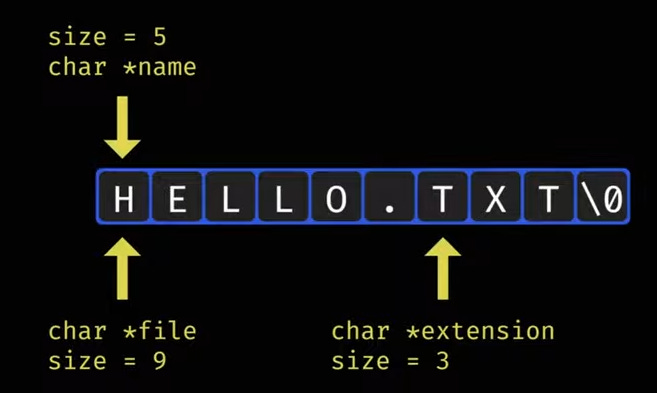
Give up on null terminator strings and instead use count based strings.
// string struct
char *str;
u64 size;
Characteristics
It uses a
char*for thestring.It uses a
u64, also known as a 64bit unsigned int for thesize.It's a combination of
std::stringandstd::string_view
The catch:
We can't tell at a glance whether a
stringhas actually beenallocatedor if it is just aview, which is important for freeing the memory.
But this isn't a problem:
The
arenain which thestringis allocated won't care about this and willfreethe memory anyways.
Benefits:
We can use the
allocated stringsandview stringsin the same functions.
string str_concat(Arena *arena, string a, string b);
string str_replace_all(Arena *arena, string needle, string replacement);
// etc
Getting
stringsizeis trivial. Null terminated strings require a loop, with our string struct, the size is immediately available.
Scuffed Templates
C's standard library lacks implementations for common data structures such as dynamic arrays, stacks, linked lists, hash tables, etc. The language also doesn't have templates.
The Solution:
Let's use the preprocessor. We can define macros that act as templates: we define macros for the code that goes in the header files, such as struct definitions and function prototypes and a different macro for the code that goes in the implementation C files.
#define MyTemplatePrototype(arg1)               \
	typedef struct arg1##datastructure {   \
		int a;                        \
		arg1 *b;                      \
	} arg1##_datastructure;                \
                                                 \
	arg1##datastructure_do_something(arg##1_datastructure *ds);

#define MyTemplate_Impl(arg1)                                          \
	arg1##_datastructure_do_something(arg1##_datastructure *ds) { \
		// do stuff!                                        \
	}
Example 1
Here's a simple template translation of a slice structure, which is essentially a pointer + length pair.
#define Slice_Prototype(type)          \
	typedef struct type##_slice { \
		type *ptr;           \
		u32 length;           \
	} type##_slice;                 \
	                                 \
	void type##_slice_subslice(type##_slice *slice, u32 start, u32 end);\
	type type##_slice_index(type##_slice *slice, i32 idx);\
#define Slice_Impl(type)\
void type##_slice_subslice(type##_slice *slice, u32 start, u32 end) {\
return (type##_slice) { slice->ptr + start, end - start };\
}\
type type##_slice_index(type##_slice *slice, i32 idx) {\
if (idx < 0 || idx >= slice->length) {\
ERROR("Slice Index Out of bounds");\
return (type##_slice) {0};\
}\
return slice->ptr[idx];\
}Now we can expose some common interface for all slices in the form of some more macros, which all take type arguments.
#define slice(type) type##_slice

#define slice_subslice(type, slice, start, end)\
	type##_slice_subslice(slice, start, end)

#define slice_index(type, slice, idx)\
	type##_slice_subslice(slice, idx)
Disadvantages:
If your program seg faults in a macro, fixing the errors you make is pure pain.
Your debugger doesn't have the actual tokens corresponding to the seg fault, so it'll break at the macro call.
Remedies:
Expand the macro using the
-E (GCC/Clang) | /P (MSVC)flag and replace your implementation macro with the code that is generated.
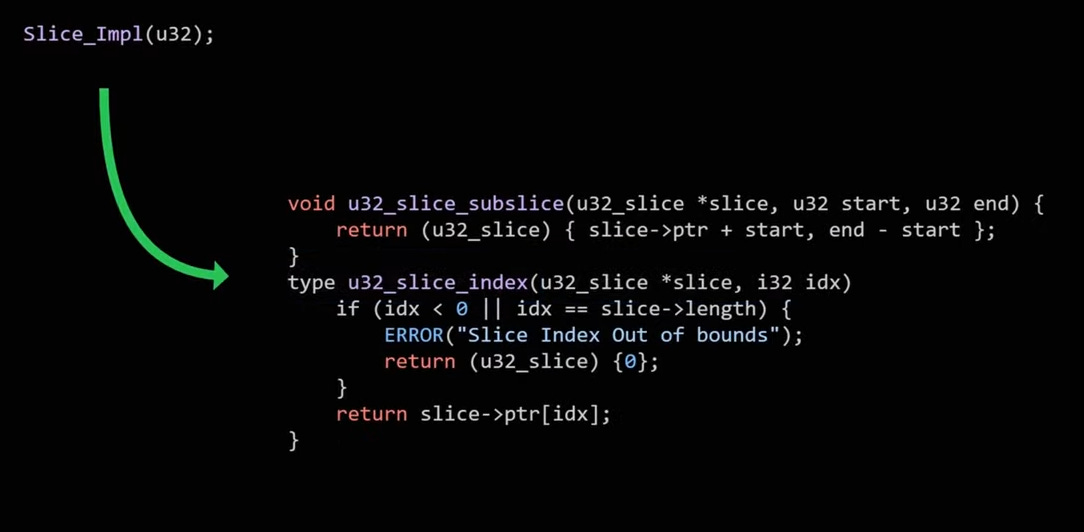
Once the error is fixed, you can go back to using the implementation macro.
Considering this is a write once, use forever approach, I don't consider this to be a bad trade-off.
Meta Programming
Another way of doing code instantiation that involves more work is Meta Programming.
This is beyond the scope of this article but in essence, we generate code from a meta file:
metafile.md -> generated.c/h
Commonly used software for this approach is metadesk.
Ryan Fleury has a great article about this approach, which I've linked alongside some other note worthy reads.
Worthwhile reads
These are extra resources that I found to be extremely useful. It's possible that I'll try to write some articles based off of them by mentioning only the key points so they serve as reminders or introductions rather than fully fledged lectures, much like this one.

VoxelRift's amazing original video - the main base of this article.